Key Takeaways
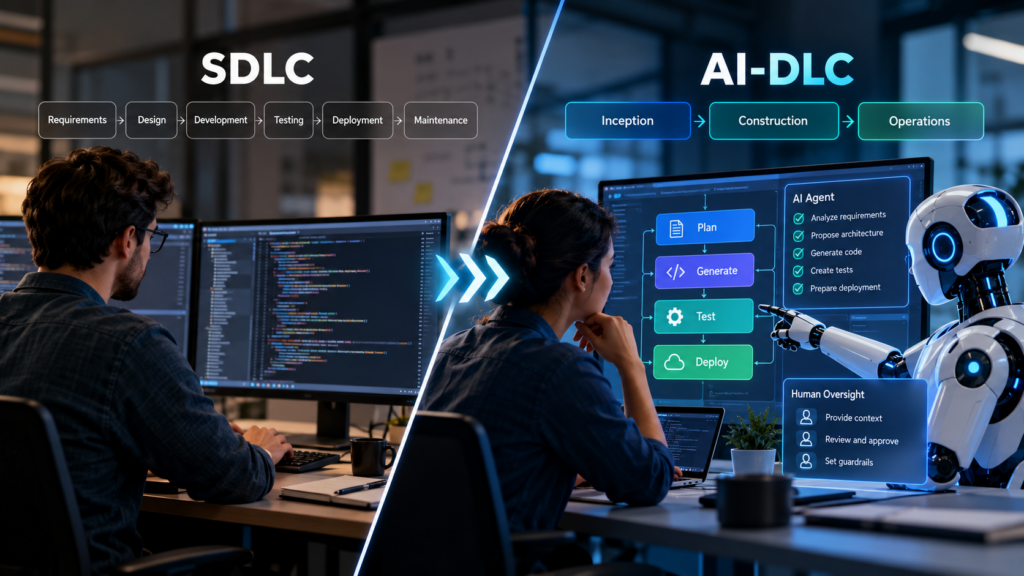
- The AI-Driven Development Life Cycle (AI-DLC), introduced by AWS in July 2025, has AI agents plan and execute work throughout the software lifecycle. People provide context and approve every consequential step.
- AI-DLC is an emerging methodology. The principles behind Agile and DevOps carry over, while the rituals built around human-paced work change.
- The engineer’s core job shifts from manually writing most of the code to directing, verifying and governing what agents produce.
- Teams are trending toward smaller, senior-weighted, cross-functional pods, and early-career hiring in AI-exposed occupations has already fallen.
- Teams with strong testing and review habits get the most out of it. Start with one small, measurable project and judge it by what actually ships before rolling it out further.
Most engineering organizations have accepted and even embraced AI, but often only minimally, by simply layering AI tools onto existing processes. Sprints, handoffs and review queues stayed the same, and the gains have been real. The harder question is what happens when the process itself is redesigned around AI agents.
The AI-Driven Development Life Cycle is bringing greater clarity on how to integrate AI in a much deeper and broader way. AWS introduced AI-DLC in July 2025 as a methodology in which AI creates a plan, asks clarifying questions and implements work only after people validate it, at every stage from requirements through deployment.
AI-DLC changes how software is built, which roles companies hire for, which skills they value and how engineering organizations are structured. This article, part of a series on how AI is reshaping engineering roles, examines both.
From SDLC to AI-DLC: What Actually Changed
The Software Development Life Cycle is the familiar sequence of phases every software product moves through: requirements, design, development, testing, deployment and maintenance. Waterfall, Agile, Scrum and DevOps are different ways of running those phases. Traditionally, each one assumes that people perform the work in every phase and that coordination between people is the main cost to manage. Sprints, backlog grooming and release trains exist to batch work into units large enough to justify that coordination.
AI has evolved through three stages within that framework:
- Human-executed SDLC. People write the requirements, design the system, write the code and run the tests. Automation handles builds and deployments.
- AI-assisted SDLC. People still plan and direct the work. AI tools speed up individual tasks such as code completion, test scaffolding and documentation, but the surrounding process stays intact.
- AI-DLC. AI initiates and directs the workflow. It proposes a plan, asks for the context it cannot infer and executes once people approve. Humans hold decision rights and accountability throughout.
AWS argues that the second stage has a ceiling. In its view, existing methods were designed for long-running, human-driven processes, and retrofitting AI into them preserves their inefficiencies. AWS also positions AI-DLC deliberately short of fully autonomous development, where AI generates entire applications with little human involvement. It describes both of those approaches as producing suboptimal results for speed and quality.
How AI-DLC Is Organized
AI-DLC runs in three phases: Inception, where AI turns business intent into requirements and units of work that the team validates together in a Mob Elaboration session; Construction, where AI proposes architecture, code and tests; and Operations, where AI manages deployments under team oversight. Two-week sprints give way to “bolts” measured in hours or days.
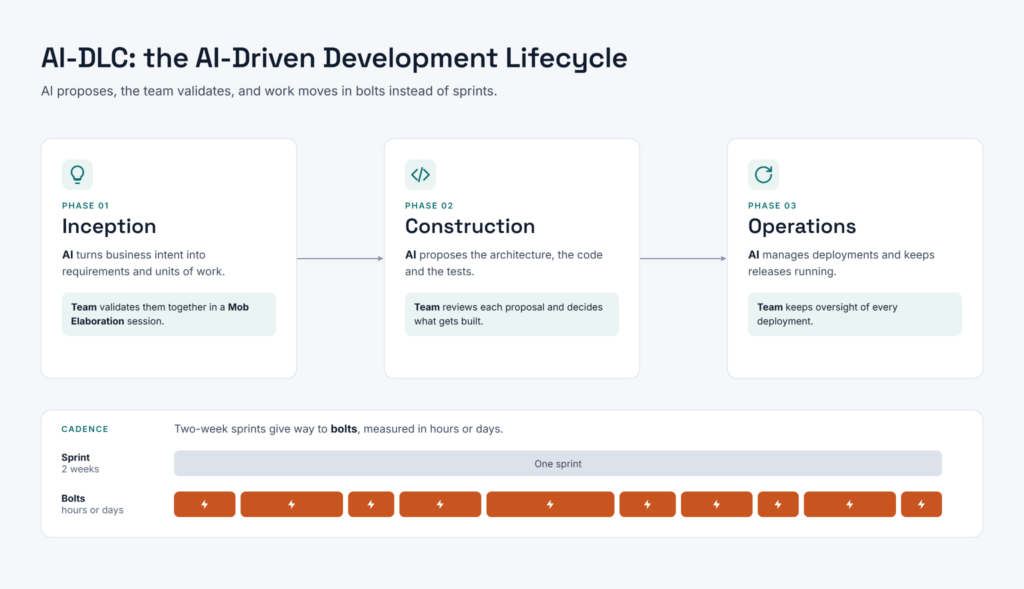
The model is still emerging. AWS open-sourced the workflow definitions later in 2025, the Operations phase is still marked as evolving and naming varies across vendors. The principles of Agile and DevOps survive the transition. Organizations that struggled with Agile for the reasons covered in Why Agile Projects Can Go Wrong will find that AI-DLC amplifies those weaknesses.
AI-DLC vs SDLC: A Phase-by-Phase Comparison
| Phase | Traditional SDLC | AI-DLC |
| Requirements | Product managers and analysts document needs | Agents draft specifications and acceptance criteria, then ask the team to resolve gaps |
| Architecture | Architects design the system | Agents propose options; architects approve the trade-offs |
| Development | Engineers write and review code | Agents generate code under human direction; engineers review against design intent |
| Testing | QA tests after development | Agents generate tests continuously; people validate risk and coverage |
| Deployment | DevOps runs release pipelines | Agents assist releases inside defined guardrails |
| Maintenance | Engineers investigate defects | Agents analyze telemetry and propose fixes; engineers approve them |
Accountability for what ships remains with people in both columns. What shifts to AI agents is the first draft. Under AI-DLC, agents produce it, and people interrogate it, so review, judgment, and the quality of the context given to agents become the limiting factors.
One Feature, Two Lifecycles
Consider a B2B software company adding self-service permission management for customer administrators. The feature touches authentication, billing access and audit logging.
Under a traditional SDLC, a product manager writes requirements over several days, the team schedules the work across sprints, engineers build it, and QA tests it afterward. The requirements that matter most, such as whether an administrator can grant themselves billing access, often surface late, when changing course is expensive.
Under AI-DLC:
- Inception. The product lead states the intent in one sentence. The agent reads the codebase, drafts requirements and asks questions: Can administrators elevate their own role? Which actions must be logged for compliance? Product, engineering and security answer them together.
- Construction. The agent proposes a flat list of roles. The security lead rejects it because enterprise contracts require permission inheritance and a full audit trail. The agent revises the design before any production code is written.
- Verification and release. The agent writes negative authorization tests alongside the code and prepares a staged rollout. Engineers review for privilege escalation, and a human approves each step to production.
The agent compresses the drafting. The outcome still depends on people who know the business rules well enough to catch what the agent assumed.
From Writing Code to Directing Development
AI-DLC shifts engineering value from writing code toward supervising workflows and verifying output. AWS reports that engineers on some of its most advanced teams handwrite only 1% to 2% of their code. In that kind of environment, five skills matter more than they used to:
- Agent orchestration: breaking work into well-scoped tasks that agents can run in parallel.
- Context engineering: grounding agents in the system’s architecture, conventions and requirements.
- System design: setting the boundaries and integration patterns that agents build against.
- Validation and governance: judging correctness, security and maintainability, and deciding what agents may touch.
- Business alignment: turning outcomes into specific, testable work.
“The software engineer of the future will be defined not solely by how much code they write, but by how effectively they direct, validate, and scale the development process.”
Recent research shows why careful review of AI output is so important. In a July 2025 randomized trial by METR, experienced open-source developers took 19% longer on real tasks when using AI tools, yet afterward believed AI had sped them up by 20%. METR’s February 2026 update suggests newer tools likely help, though its authors call that evidence weak. Veracode’s 2025 testing of more than 100 models found that generated code introduced OWASP Top 10 vulnerabilities in 45% of cases. The engineer who can spot a flaw in plausible-looking code is worth more than the one who can type it quickly.
How AI-DLC Changes Engineering Team Structure
Traditional organizations typically hand work across functional specialties: product defines it, engineering builds it, QA tests it, and operations runs it. AI-DLC compresses those handoffs into shared sessions, which favors cross-functional pods. The comparison below is an illustrative model.
| Traditional functional organization | Potential AI-DLC organization |
| VP Engineering / CTO | VP Engineering / CTO |
| Product Management | AI-Native Product Lead |
| Engineering Managers | AI Development Leads / Orchestrators |
| Software Developers | Full-Stack / Systems Engineers |
| QA / Testing | AI Quality and Validation |
| DevOps / SRE | Agent Platform / Infrastructure |
| Architecture / Security | Systems Architecture / AI Governance |
Several patterns are emerging:
- Smaller, senior-weighted pods. AWS reports that six senior engineers rebuilt the Amazon Bedrock inference engine in 76 days, a project scoped for 30 developers over 12 to 18 months. AWS is describing its own team, so the result is best read as a best case.
- Shared specialists. Security, data and platform experts serve several pods and join sessions as needed to provide their judgment.
- Overlapping hours. Elaboration sessions are synchronous, which affects how companies staff their distributed and nearshore teams.
- A stronger platform function. The 2025 DORA report linked internal platform quality directly to an organization’s ability to get value from AI.
Ownership of architecture, security and reliability is becoming more important. When agents generate change quickly, the people who set boundaries, approve access, and own production stability keep speed from turning into risk.
How AI-DLC Changes Hiring
For hiring leaders, the bigger change is in what each role requires. The profiles below are emerging rather than established titles.
| Traditional role | Potential evolution | Hiring emphasis |
| Software Developer | AI-Native Software Engineer | AI workflows, rigorous review, system judgment |
| Senior Software Engineer | AI Development Lead or Forward-Deployed AI Engineer | Orchestration, decomposition and design |
| QA Automation Engineer | AI Quality and Validation Engineer | Evaluation design, test strategy, quality gates |
| DevOps Engineer | AI Platform Engineer | Agent environments, access control, observability |
| Technical Product Manager | AI-Native Product Manager | Agent-ready specifications and acceptance criteria |
| Software Architect | AI Systems Architect | Architecture, boundaries and integration patterns |
| Engineering Manager | AI-Native Engineering Manager | Quality standards, coaching and review capacity |
Breadth Over Narrow Specialization
When agents absorb implementation within a specialty, value shifts toward judgment across specialties. That is the pattern described in The Rise of the Full-Stack Employee: How AI Is Creating a New Generation of Jobs, and The Rise of the Forward-Deployed AI Engineer covers one visible example. Companies will still need deep specialists for security, performance and regulated work, though more of them will support several teams at once instead of sitting on just one.
Interviews That Test Judgment
The classic coding interview, where a candidate writes code from scratch on a whiteboard, tests a skill that agents can now handle. But a candidate who is good at prompting and weak on fundamentals is a risk of a different kind. The interview should test both skills. Hand candidates a pull request an agent wrote, with a flaw buried in it, and see if they catch it. Ask them to write a spec an agent could build from, or to pick apart a design an agent proposed.
Leaner, More Senior Teams
When agents handle the first drafts, experienced engineers who can judge that work become the scarce resource. A small senior team that directs and reviews well can deliver more than a larger team that cannot.
The Junior Pipeline
The August 2026 revision of Stanford’s “Canaries in the Coal Mine?” study found that workers aged 22 to 25 employed in AI-exposed occupations is 19% below where it would be had it kept pace with less-exposed peers, mainly through reduced hiring. Experienced workers show no comparable gap, and the authors describe the findings as early indicators rather than causal estimates. If entry-level implementation is automated, companies lose the traditional path from junior to senior engineer. Pairing junior engineers with seniors in review sessions and hiring them into validation and platform roles can help rebuild it.
The Economics of AI-DLC
The business case rests on shorter cycle times, higher throughput and faster progress on technical debt. AWS reports a median 4.5x gain in normalized deployment velocity in structured pilots at Amazon Stores, with some teams above 10x. Teams that changed both their tools and their practices outperformed those that simply added AI to existing workflows. These are AWS’s results about its own teams.
Independent data is more cautious. The 2025 DORA report, based on nearly 5,000 technology professionals, found that AI adoption now correlates with higher delivery throughput but still correlates with lower delivery stability. It concludes that AI makes strong engineering teams better and worsens the problems of struggling teams.
The costs include token spend that grows with agent activity, rework when a flawed specification spreads across every unit of work, security exposure, governance overhead and senior review time. The right measures are lead time, change failure rate, escaped defects, progress on the debt covered in Tips for Managing Technical Debt and business outcomes. Lines of generated code and assumed headcount cuts are poor indicators.
What Technology Leaders Should Do Now
- Assess bottlenecks. Find where delivery time actually goes: requirements, review queues, testing or releases.
- Pilot on bounded work. Choose one service, give a small team permission to restructure how it works and record baseline metrics first. AWS found that its best teams slowed down at first while they built agent context, so allow time.
- Define controls. Decide who approves agent plans, what agents can access, how generated code is scanned and what test coverage is required.
- Map competencies. Decide which orchestration, validation and design gaps to close through training, hiring or contract support.
- Trial pods before reorganizing. Run one or two cross-functional teams and scale from evidence.
Human-Directed, AI-Executed
AI-DLC is a potential operating-model change that extends beyond coding tools to include planning, staffing and governance. Any competitor can license the tools. Lasting advantage will come from redesigning workflows, building the skills that make agent output trustworthy and keeping accountability with people. The open questions for leaders are whether the full-stack AI engineer becomes the default profile, how to rebuild the path from junior to senior engineer and whether delivery capacity comes to depend more on orchestration than on headcount.
Is Your Engineering Team Built for AI-Driven Development?
If you are evaluating whether your engineering team has the talent and structure for AI-driven development, connect with Zilker Partners to discuss the roles, hiring model and team design that fit your roadmap.
Frequently Asked Questions
What is AI-DLC?
AI-DLC, the AI-Driven Development Life Cycle, is a software development methodology introduced by AWS in July 2025. AI agents plan and execute work across requirements, design, construction and operations, while people provide business context and approve every consequential decision.
What is the difference between AI-DLC and the SDLC?
In a traditional SDLC, people produce the first version of nearly every artifact and work moves between specialists in sprints. In AI-DLC, agents produce those first versions, and people validate them in short cycles called bolts. Accountability for what ships stays with people in both models.
Does AI-DLC replace Agile?
Not in principle. Short feedback loops, frequent validation and working software remain the goals. Two-week sprints and handoff-heavy ceremonies give way to shorter cycles and shared working sessions with the agent.
How will AI-DLC affect junior engineers?
Entry-level hiring in AI-exposed occupations has already slowed. Stanford research found employment of workers aged 22 to 25 in those occupations is 19% below where it would be had it kept pace with less-exposed peers. Employers that want a future senior bench need deliberate development paths, such as structured pairing and review-based training.

Chief Executive Officer, Zilker Partners
Jeff brings deep expertise in recruiting, IT, digital, and service delivery to Zilker Partners, leveraging his experience spanning telecom, IBM, and Dell. As CEO, he approaches every project with a focus on aligning people, process, and technology, ensuring efficient execution and successful outcomes through a balanced, integrated delivery strategy.

